
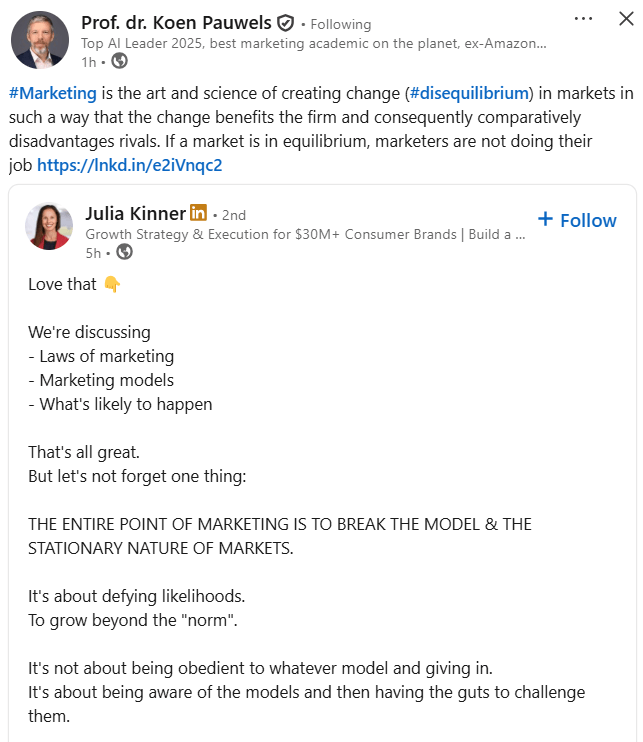
I encountered something on LinkedIn when I logged in to see what my network and peers are talking about. There was this interesting post from Prof. Dr. Koen Pauwels that piqued my interest:
The link to the post is here.
This made me think back to the time that I was studying strategy.
Back when I was a marketing student, my professor once shared an important insight: markets naturally tend to grow over time. Simply placing a product or brand on store shelves will typically result in sales—leading to steady, organic growth. The same principle applies equally to competing brands. Left alone, every brand within a given category will likely experience some degree of growth.
This raises a fundamental question: If growth is inevitable, what’s the real purpose of strategy and marketing?
The role of strategy is to short-circuit that growth and hasten it such that it benefits the brand.
The role of strategic marketing lies in accelerating growth beyond this natural baseline. Strategy is not about simply riding the wave of organic market expansion. It is about proactively shaping market dynamics to benefit your brand more than others. Put simply, the core objective of marketing strategy is to create an unfair advantage, tipping the scales in your brand’s favor.
The LinkedIn post says it so beautifully:
Marketing is the art and science of creating change disequilibrium in markets in such a way that the change benefits the firm and consequently comparatively disadvantages rivals. If a market is in equilibrium, marketers are not doing their job.
(Emphasis mine)
– Prof. Dr. Koen Pauwels
The role of strategy in marketing is, therefore, to drive the market to disequiblibrium.
Strategic marketing deliberately disrupts market equilibrium. Instead of passively accepting the incremental growth that naturally occurs, effective strategy aggressively propels a brand forward, accelerating its trajectory ahead of competitors. It is about disproportionately amplifying results, driving sales and revenue outcomes that would not materialize through organic market forces alone or through the passage of time alone.
In other words, great marketing doesn’t merely coexist with market trends; it shapes them. Strategic marketing positions your brand as the go-to choice, compelling consumers to pick it off the shelves instead of the competition’s.
Ultimately, the real purpose of marketing strategy is clear: to not just participate in growth, but to own it.
 Numerate Geek
Leave a comment